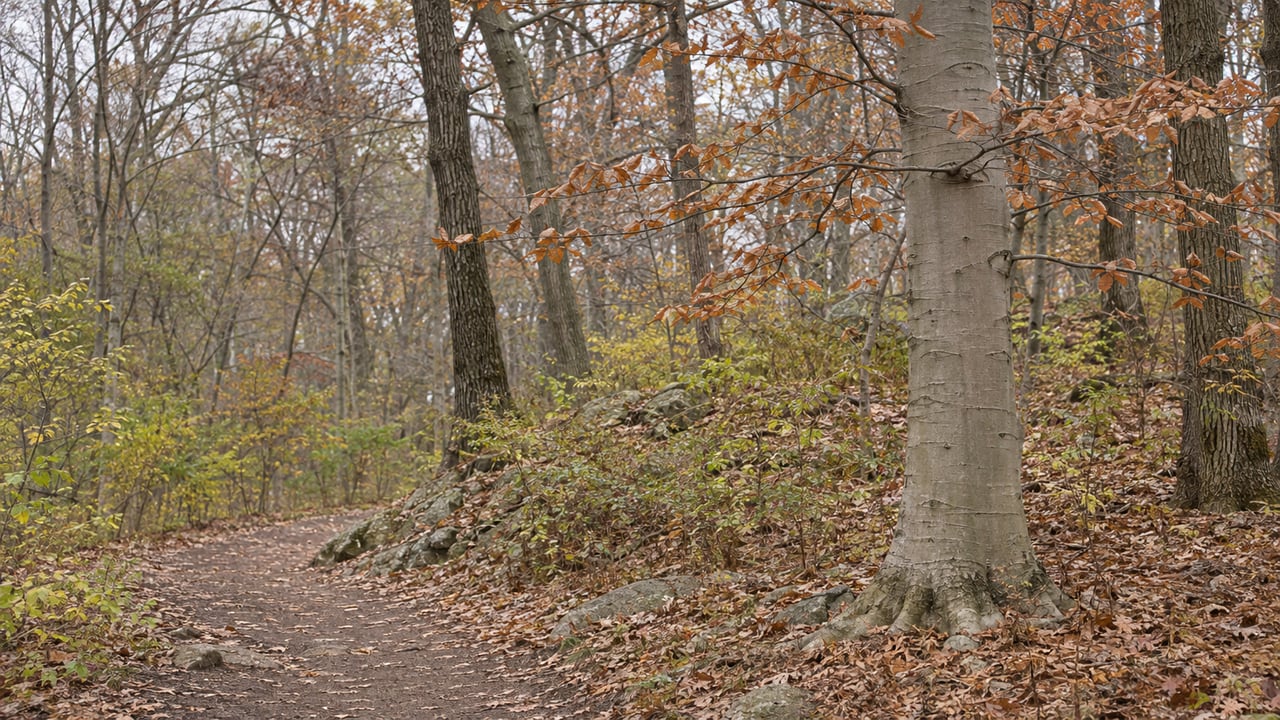
What Beech Leaf Disease Means for the Tenafly Nature Center Trails
November 19, 2026
November 19, 2026
Next summer, look up at a beech along the Tenafly Nature Center trails and you may see dark stripes running between the leaf veins, like a fine barcode printed on each leaf. Leaf edges curl and turn leathery, and over time the crown thins from the bottom up. Rutgers adds that heavily infected leaves thicken, distort and drop early. In several stands at the Nature Center, that pattern is on every American beech.
That changes what the new state money at 313 Hudson Avenue is for. In September, the New Jersey Department of Environmental Protection awarded the Tenafly Nature Center Association $566,290 to restore 24 acres of forest. Some of it goes to treating beech trees. The rest of the work listed is about the next forest: which native trees replace the beeches as they decline, how those saplings get past the deer, and who plants them. You can help with that last part starting next spring.
The NJDEP says beech leaf disease was confirmed in New Jersey in the summer of 2020, in Bergen and Essex counties. Rutgers Cooperative Extension traces it to a microscopic foliar nematode, Litylenchus crenatae subsp. mccannii, which lives in beech buds and leaves.
How fast it works depends on the size of the tree. Rutgers' beech leaf disease fact sheet says the disease can kill American beech in anywhere from 2 to 10 years, depending on the tree's size. So a mature beech that looks fine from the trail can be years into its decline.
That's a big deal at the Nature Center. In fall 2025, TNC finished an inventory that mapped beech across about 15 acres of the preserve, and it described that mapping as the first step in planning replacements. The 24-acre grant area is bigger than the beech footprint alone. That fits a project that covers invasive plants and new plantings as well as the beeches themselves.
TNC calls it a three-year project. Its program description lists four kinds of work, and the state's award announcement lines up with them.
| Work funded | What it means on the ground |
|---|---|
| Tree treatment | Targeted beech leaf disease treatments on selected beeches |
| Tree removal | Taking out declining beeches as the stands give way |
| Invasive species control | Clearing aggressive plants that crowd out young native trees |
| Native tree planting with deer protection | A large-scale planting of mixed native species, shielded from browsing |
TNC Executive Director Debora Davidson explained the goal in the NJDEP's September 22 announcement:
"This funding allows us to get ahead of a disease that would otherwise reshape our forest for a generation. By replacing declining beech stands with a diverse, climate-resilient mix of native species, we're not just responding to a threat, we're strengthening the forest's ability to store carbon and support wildlife for decades to come."
The grant came from the state's Natural Climate Solutions Grant Program, in a round of eight projects across seven counties. Tenafly isn't the only place on that list dealing with dying beeches. Passaic County received $1,477,471 to restore 49 acres in West Milford Township, at a site the state describes as affected by invasive species, soil degradation, extensive beech tree mortality and wildfire. That project plans 12,200 trees. Next to it, the Tenafly award is a smaller, focused job on a preserve that thousands of Northern Valley residents use as their nearest woods.
TNC also notes that the project carries on its long partnership with the Borough of Tenafly to meet the conservation goals in the preserve's original Green Acres purchase agreement.
Deer are the reason "with deer protection" appears in TNC's description of the planting. In its fall 2025 conservation update, TNC called its "ever-present" white-tailed deer a reminder of how hard it is to balance wildlife populations with a healthy forest. Saplings left unprotected in a heavily browsed woodland rarely grow into canopy trees.
The same update shows what kind of forest TNC wants. Its fall 2025 plan called for 400 native trees around the front entrance and along the White Trail, including red oak, white oak, shadbush and sweetbay magnolia. TNC picked them partly because oaks support hundreds of species of insects and caterpillars, which feed birds and mammals. That plan was separate from the new grant. Even so, it shows the mixed native canopy Davidson describes.
Invasive removal fits the same goal. Last fall, TNC's stewardship crews focused on stilt grass and mile-a-minute vine, two plants that smother native growth and keep a forest from regenerating. When old beeches come down and sunlight reaches the forest floor, the young native trees have to outgrow whatever else moves into that light.
Planning a winter walk? TNC no longer stocks paper trail maps onsite. Its interactive digital trail map is on the Nature Center's website. In its fall 2025 update, TNC also said the next phase of restoration at Pfister's Pond was slated to begin that fall, funded by a Green Acres grant with support from the borough.
The project has openings for anyone who wants to do more than watch the woods change. In date order:
A second grant, from the Association of New Jersey Environmental Commissions, lets TNC work with the Tenafly Environmental Commission to share information about beech leaf disease and organize volunteers. For volunteers, that means two local organizations will be working on the spring planting together.
If you're putting together a list of winter outings in town, our guide to family-friendly things to do around Tenafly and our look at downtown Tenafly's newest restaurants pair well with a morning on the trails.
A lot of Tenafly's older properties have big beech trees, and the disease doesn't stop at the preserve boundary. The NJ Forest Service lists these signs:
The bands are easiest to see when you look up at leaves with light behind them, so next spring's new leaves are the time to check.
Rutgers' February 2025 bulletin reviews the treatments researchers have studied. It names thiabendazole injection, sold as Arbotect 20-S, as the most effective option it discusses. It gives June as the best timing in New Jersey and says this treatment works best on larger beeches with less than 50 percent dieback or defoliation. It describes phosphite soil drenches and fluopyram as promising but still experimental. The bulletin also says no cultural practice has been shown to prevent the disease. It points to ways of reducing stress on a tree instead: watering during drought, removing invasive plants, avoiding soil compaction, and leaving beech leaf litter in place. If you think a tree on your property has it, the NJ Forest Service advises contacting a certified tree expert to talk through treatment options.
Mature trees shape how a Tenafly street looks and how a yard feels, and I talk with homeowners about them all the time. If a large beech on your property has you thinking about your home's curb appeal or value, or about timing a sale around landscape work, Chris Crawford Homes is glad to walk the property with you. Request your free market consultation, and you can also browse our Tenafly neighborhood guide.
I work with sincerity and have built my company's foundation on the strong values of integrity, efficiency, client advocacy, and results. I have many years of experience with project management before diving into the real estate industry, and I go the extra mile to deliver customer satisfaction. Begin your journey into real estate with me today.